Project in Stages
First Stage
Type of Work: Installation / Public Intervention
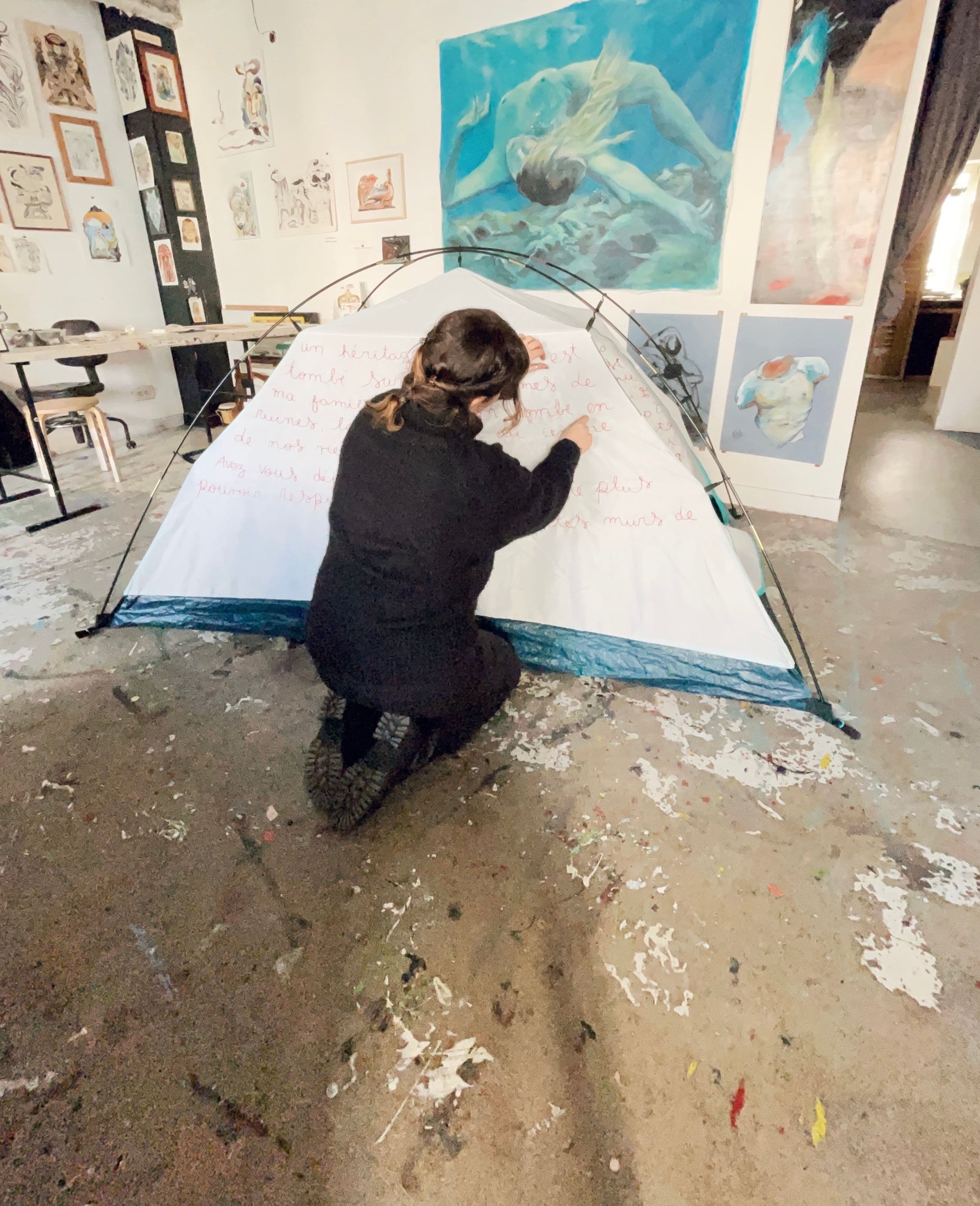
Support: Tent Dimensions: 130 × 210 × 107 cm Technique: Hand-embroidered text
Description In this first stage, the work is presented as a tent installed in public space. On its surface, an autobiographical text is hand-embroidered, reconstructing childhood memories, domestic scenes, and family bonds shaped by precarity, care, and loss.
Before constructing the installation, the tents were photographed using 35 mm analog film. From these images, the artist built her own tent, onto which she embroidered the text of her childhood. These photographs also serve as the basis for the second stage of the project, where they are transformed into real estate posters using the actual locations of the tents and the captured images.
The tent bridges two worlds that are usually separate: home and street. It functions both as an intimate refuge and as an exposed structure, shifting the idea of home toward something fragile and provisional. By being placed in different neighborhoods, the work invites multiple readings depending on the urban context, questioning notions of home, belonging, and protection.
The act of embroidery—slow, repetitive, and domestic—inscribes memory onto a precarious support. The house appears as body, inheritance, and ruin: a legacy transmitted across generations of women, marked by material and emotional instability.
Embroidered Text The room had two identical beds, heart-shaped pillows, two floral quilts, matching nightstands, pink lamps. Every night, before going to sleep, someone would come to say goodnight. If it was my grandmother, she took her time. I see her with the boldo tea in her hand and the stirring straw in the cup. I felt grown-up drinking that floral-scented tea. I loved all her rituals and her sweetness. If it was my mother, everything was quicker: a short kiss, tucking us in without straightening the sheets, turning off the light. There was no time. Yet if she had stayed, I could have spent hours watching her—I saw her so beautiful and sad at the same time; motherhood was never meant for her.
When I turned four, my parents separated, the house was a mess, we were too. Imagination became my refuge. I liked playing in the kitchen, jumping and connecting the uneven tiles with the triangles drawn by my feet. The roof was made of metal sheets—I could be inside a storm even if only a few drops fell outside. As a child, I loved playing with what I had.
I close my eyes tightly and walk until I reach the entrance hallway. My hands touch the walls; everything is rough, uncoated, all cement. I stop pretending I don’t see, and there you are, Grandma Yaya, with the watering can. I touch the plants one by one. A slow shiver runs through me; my hands feel a warm energy, and this vegetal love makes me aware of the moment’s finitude. You are there, gesturing, smiling. The back-and-forth between bucket and can creates life.
A legacy of cement has fallen upon the women in my family. The house is crumbling; precarity is at the center of our lives. Have you ever felt like you cannot breathe? It’s as if the walls of your house collapse on your chest. I see myself emerging from the rubble, joining my lineage. Before me, a door with the number one hundred twenty-two. In that house lived the girl I am not. Yaya, I follow the traces of your footsteps. I know I will piece together the fragments of our essence. Grandmother, don’t worry—I am standing on our remains.
Second Stage: À Louer
Type of Work: Urban Intervention / Public Space Action
Support: Photographs printed in various formats
Description In this second stage, titled À Louer, the photographs of the tents are transformed into real estate advertisements. The images adopt the aesthetics, format, and visual language of the real estate market and are manually pasted in various neighborhoods of Paris.
Using irony, the work appropriates the codes of real estate advertising to create a contrast between the promise of a home and the reality of housing precarity. Where sales and rental ads are usually displayed, fragile shelters appear instead.
This action seeks to highlight the housing problem and the growing urban population left without access to housing. The intimate narrative shifts into public space and becomes collective, exposing the structural violence of a system that turns home into commodity.
Au Milieu de Murs Fragiles is an ongoing project that connects memory, territory, and heritage, where the home appears as an unstable space, yet also as a place of resistance and transmission.